Plataforma de Inteligencia Ciudadana con IA
Ayuntamiento de Mataró · Oficina de Datos
Cómo hemos añadido dos nuevas dimensiones de análisis — sentimiento y criticidad — a +35.000 mensajes ciudadanos, con actualización diaria automática y un chatbot conversacional para consultar el estado del municipio en tiempo real.

Datos con contexto
El Ayuntamiento de Mataró se enfrentaba a un reto silencioso: tenían datos, pero les faltaba contexto. Podían clasificar los mensajes ciudadanos por canal, barrio o temática, pero no sabían cómo se sentían sus ciudadanos ni qué situaciones eran realmente urgentes.
Junto con Optimtech, en 4 meses construyeron una plataforma de IA que añade dos nuevas dimensiones al análisis: sentimiento y criticidad, con actualización diaria automática y un chatbot conversacional para consultar el estado del municipio en tiempo real.
El cliente
- Organización
- Ayuntamiento de Mataró
- Área
- Oficina de Datos
- Interlocutores
- Anna Quer i Rodríguez · Laura Sunyol Bert, Directora de Innovación y Transformación Digital
- Usuarios internos
- 5–10 personas
- En producción desde
- Febrero 2026
Mataró es una ciudad costera de más de 130.000 habitantes y uno de los municipios más innovadores de Cataluña en cuanto a transformación digital. La Oficina de Datos es el equipo responsable de convertir los datos del municipio en inteligencia accionable para mejorar la toma de decisiones.
Sabían qué se decía, pero no cómo ni con qué urgencia
El Ayuntamiento ya disponía de un dashboard interno que le permitía clasificar los mensajes entrantes de los ciudadanos según tres dimensiones: Canal (por dónde llegaba el mensaje), Barrio (de qué zona de la ciudad) y Temática (de qué trataba).
Pero faltaban dos dimensiones clave para entender realmente el pulso de la ciudad:
Criticidad
¿Cómo de urgente es la situación que vive este ciudadano o familia? ¿Es una queja leve o una situación crítica que requiere atención inmediata?
Sentimiento
¿Con qué tono se comunican los ciudadanos? ¿Hay frustración generalizada en algún barrio? ¿Hay temas que generan especialmente malestar?
Sin estas dos dimensiones, el equipo tomaba decisiones con información incompleta. El detonante fue claro: el equipo de innovación vio que la IA generativa podía automatizar este análisis con una precisión que antes era imposible de escalar manualmente, con más de 35.000 mensajes acumulados y cientos de nuevos mensajes entrando cada semana.
4 meses, 5 fases, un equipo de 3 personas
El proyecto se desarrolló siguiendo un proceso colaborativo con el equipo del Ayuntamiento.
Descubrimiento y definición
Entendimos en profundidad cómo trabajaba la Oficina de Datos, qué datos tenían, cómo llegaban los mensajes y cuál era exactamente la brecha que necesitaban cubrir. No llegaron con una solución predefinida: construimos la solución juntos.
Diseño de la solución
Definimos las dos dimensiones de análisis (sentimiento y criticidad), sus escalas, los criterios de interpretación y cómo se integrarían con el flujo de trabajo existente. También diseñamos la arquitectura de datos y el modelo de anonimización.
Desarrollo
Migración de los 35.000+ mensajes históricos, desarrollo de la API de análisis con Azure OpenAI, implementación de la capa de anonimización, desarrollo del chatbot conversacional con búsqueda semántica y automatización del pipeline de ingesta diaria.
Ajuste y validación
La fase más delicada del proyecto. Trabajamos iterativamente para afinar el modelo LLM hasta obtener resultados coherentes y fiables, y para eliminar alucinaciones del chatbot asegurando respuestas basadas exclusivamente en los datos reales del municipio.
Despliegue y producción
Despliegue en Azure, configuración de la automatización diaria y formación del equipo interno.
Una plataforma con tres componentes principales
Motor de análisis automático
Cada mañana, los nuevos mensajes ciudadanos son procesados automáticamente por un modelo de lenguaje (GPT-4.1 en Azure OpenAI) que asigna puntuación de sentimiento (0–10), puntuación de criticidad (0–10) y anonimiza automáticamente todos los datos personales.
Base de datos vectorial
Todos los mensajes se almacenan con embeddings vectoriales, lo que permite hacer búsquedas semánticas (por significado, no solo por palabras clave) sobre los 35.000+ mensajes del historial.
Chatbot conversacional en tiempo real
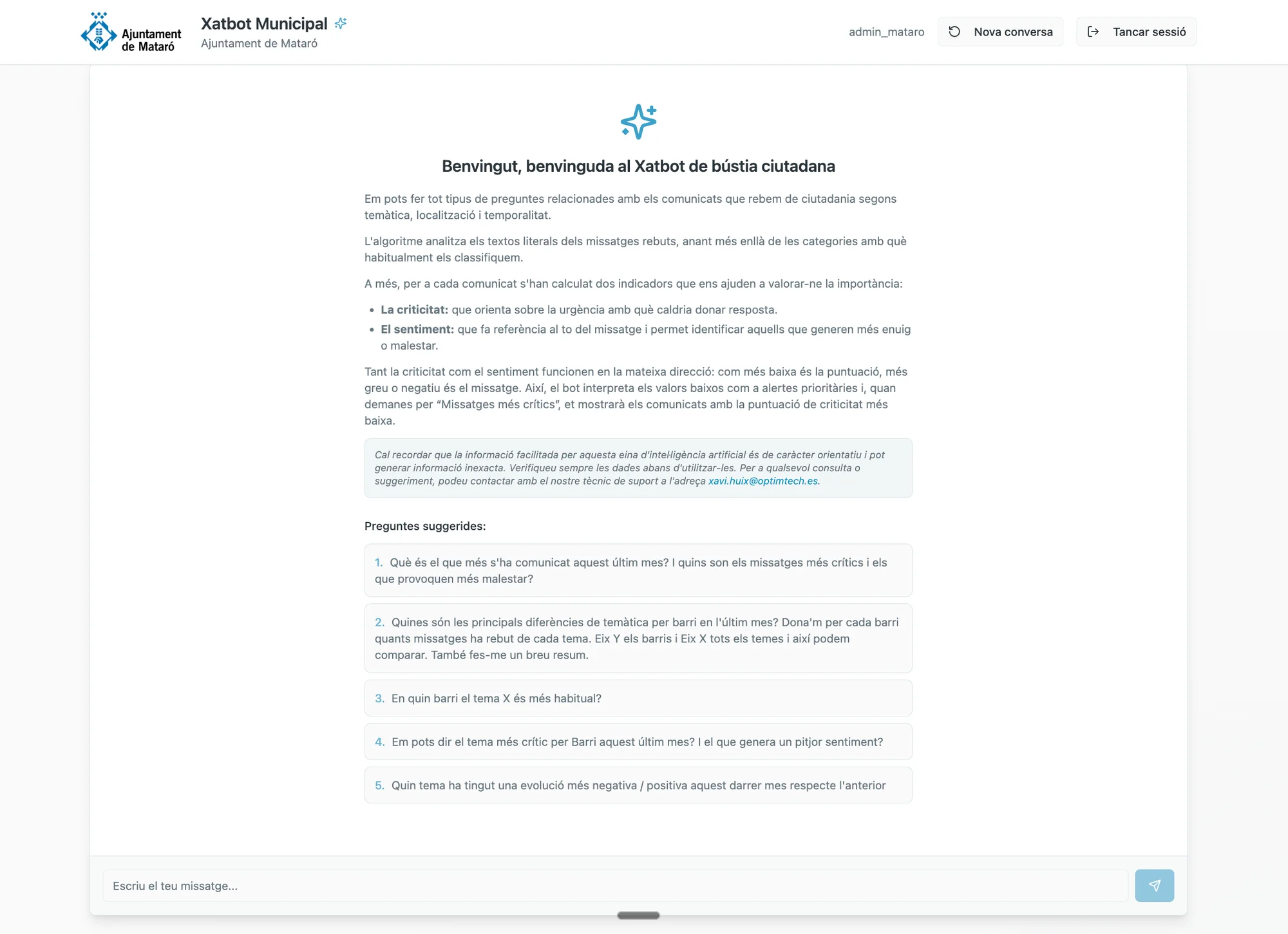
Una interfaz de chat donde los técnicos municipales pueden preguntar en lenguaje natural: "¿Cómo es el sentimiento general este mes en el barrio de Cirera?" El sistema responde con datos reales, sin inventar ni alucinar.
Stack tecnológico
| Capa | Tecnología |
|---|---|
| IA y LLM | Azure OpenAI (GPT-4.1 + embeddings text-embedding-ada-002) |
| Base de datos | PostgreSQL Flexible Server con extensión pgvector |
| Backend | Node.js + TypeScript + Express |
| Frontend | React + TypeScript + Vite + Tailwind CSS |
| Infraestructura | Azure App Service + Azure Static Web Apps |
| Seguridad | Azure Key Vault + JWT Authentication |
| Monitorización | Azure Application Insights |
Por qué estas decisiones técnicas
- Azure OpenAI en lugar de OpenAI directamente: los datos ciudadanos quedan dentro del entorno Azure de la UE, cumpliendo los requisitos de soberanía de datos y RGPD.
- pgvector sobre soluciones vectoriales independientes: permite la búsqueda semántica en la misma base de datos relacional, reduciendo complejidad y coste operativo.
- Anonimización en el pipeline: antes de que ningún dato llegue a la base de datos, se eliminan automáticamente todos los datos personales.
Problemas superados
Coherencia del análisis de sentimiento
El mayor reto fue conseguir que el modelo LLM aplicara los criterios de análisis de manera consistente en miles de mensajes con contextos muy diferentes. La solución requirió múltiples iteraciones de afinamiento de prompts, validación cruzada con el equipo del Ayuntamiento y definición de criterios explícitos de interpretación.
Chatbot sin alucinaciones
Un chatbot sobre datos municipales no puede inventar información. Implementamos un sistema de function-calling donde el modelo tiene acceso solo a herramientas que consultan la base de datos real, sin posibilidad de generar respuestas basadas en conocimiento externo.
Privacidad y anonimización
El Ayuntamiento hizo especial hincapié en que ningún dato sensible de los ciudadanos quedara almacenado. Desarrollamos una capa de anonimización que detecta y sustituye automáticamente nombres, teléfonos, emails y otros datos personales.
Impacto medible
+35.000 mensajes históricos migrados, analizados y disponibles para consulta
Dos nuevas dimensiones de análisis (sentimiento y criticidad) integradas en el flujo existente
Pipeline automático diario: los nuevos mensajes se analizan cada mañana sin intervención manual
Consulta en tiempo real del estado emocional del municipio vía chatbot conversacional
Plataforma en producción desde febrero 2026, en uso activo por el equipo de la Oficina de Datos
Cumplimiento total de privacidad: cero datos personales almacenados en el sistema
Inteligencia ciudadana en tiempo real
La mayoría de soluciones de mercado para la administración pública ofrecen análisis estático y retroactivo. Esta plataforma ofrece algo diferente:
El equipo puede preguntar hoy cómo se siente la ciudad hoy, con datos de esta mañana, en su propio idioma (castellano y catalán), y obtener respuestas contextualizadas basadas en el historial completo del municipio.
No es un informe mensual. No es un dashboard con filtros. Es una conversación con los datos de la ciudad.
IA que transforma sin disrupción
Este proyecto demuestra que la IA aplicada a la gestión pública no necesita ser disruptiva para ser transformadora. El Ayuntamiento de Mataró no cambió cómo trabaja: añadió dos capas de inteligencia sobre lo que ya tenía, con un proceso colaborativo, en un tiempo razonable y con un enfoque riguroso en la privacidad.
El resultado es un equipo que ahora puede tomar decisiones con más contexto, priorizar mejor y entender el pulso real de sus ciudadanos.